Your Savings Account Pays 0.37%. X Money Pays 6%.
How X Money helps you meet your savings goals
We could all save more money.
Sometimes the issue is overspending or bad budgeting. But most of the time the problem is the account you use to park your money.
The national average savings account interest rate is 0.37% APY (interest). That is as good as nothing.
The common advice is if you want to seriously save money, go search for HYSA (High Yield Savings Account) custodians and compare their APY/interest rates. Some HYSAs will offer you promotions, like a 0.5% APY boost for the first 6 months.
Some HYSA offerings will incentivize you to try and “combo” your money, by having a HYSA and a checking account through the same company. Another common promo is to give you $X free money on $Y deposited amount as a bonus for trusting your savings with the HYSA provider.
Thing is, the APY boost is temporary, and a combo bonus is usually there to distract from a middling 2.4-3% APY offering.
Rates and incentives change, but the space is ripe for competition.
That’s where X Money comes in.
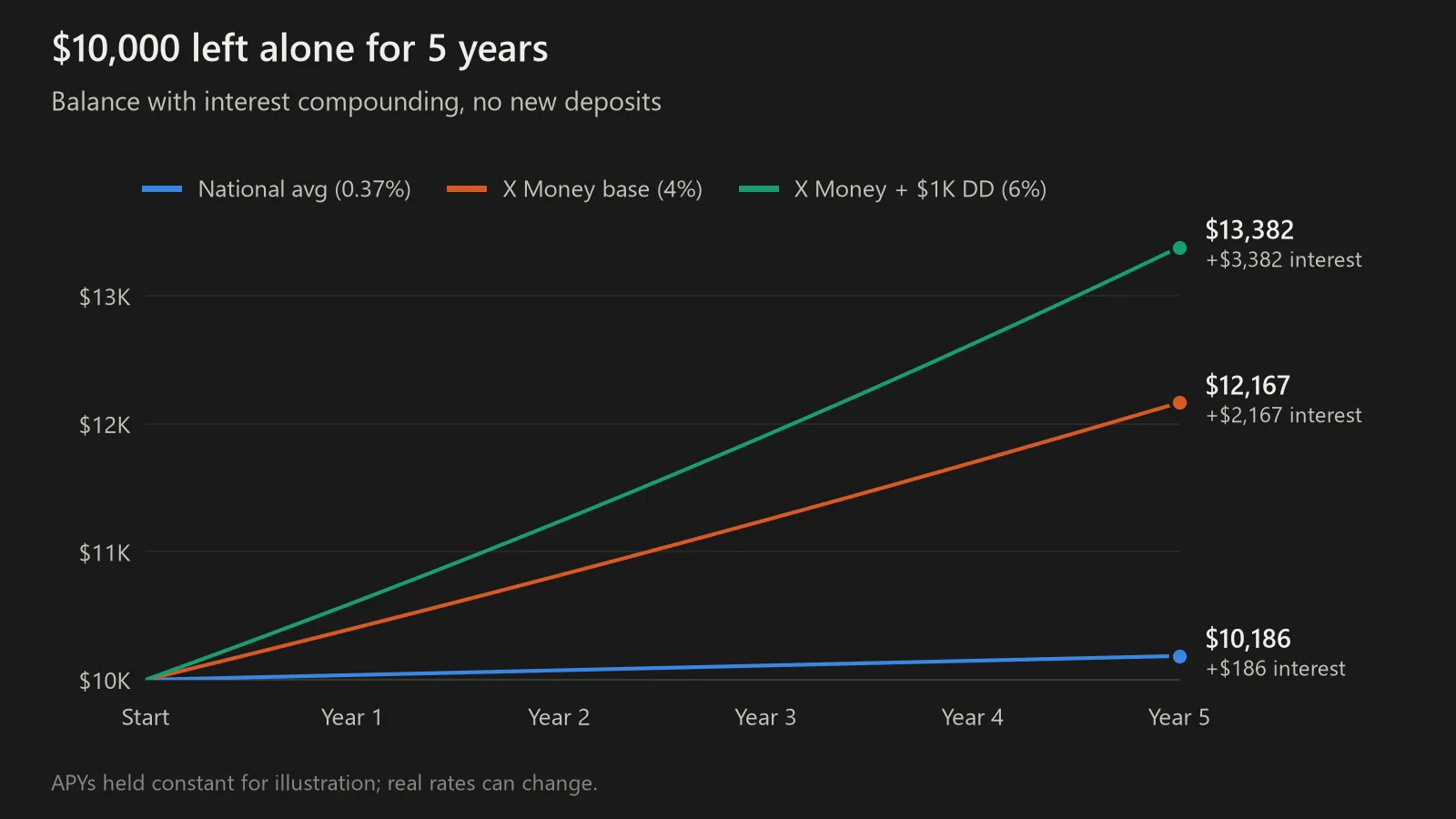
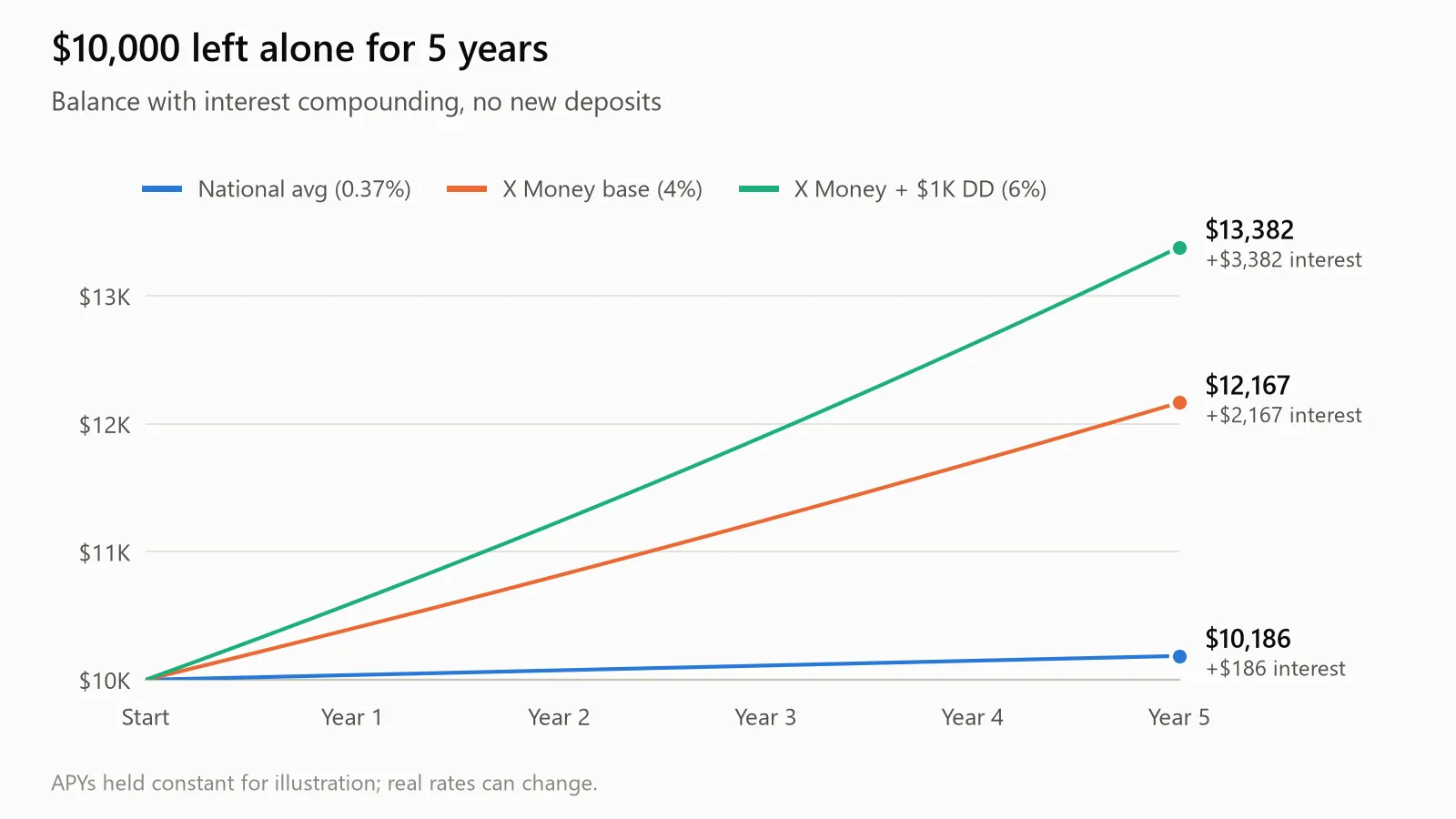
X Money offers a base 4% APY and a very competitive 6% APY if you direct deposit $1K a month into it.
Even if X Money drops the rate to 5%, it beats most HYSA offerings.
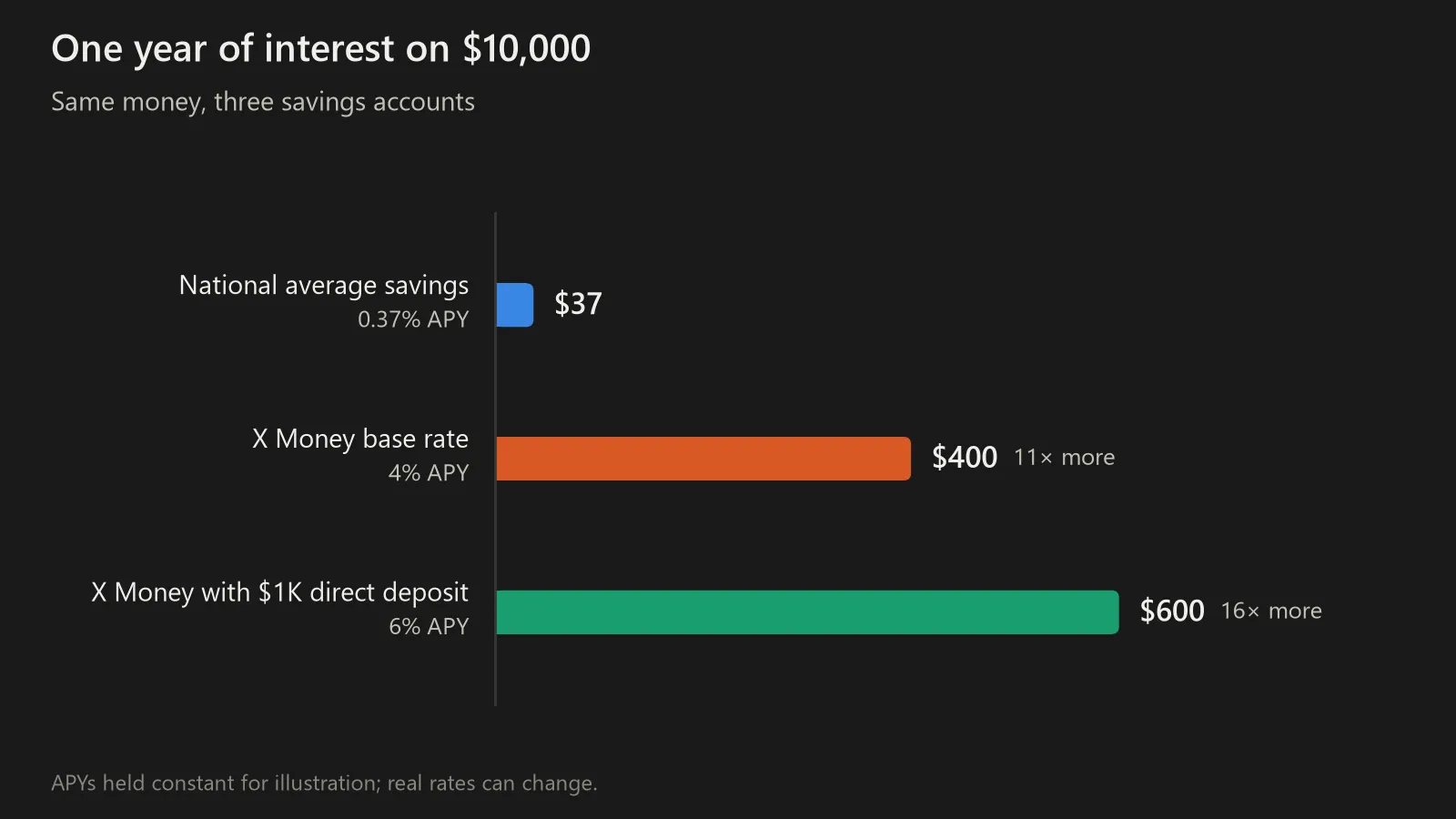
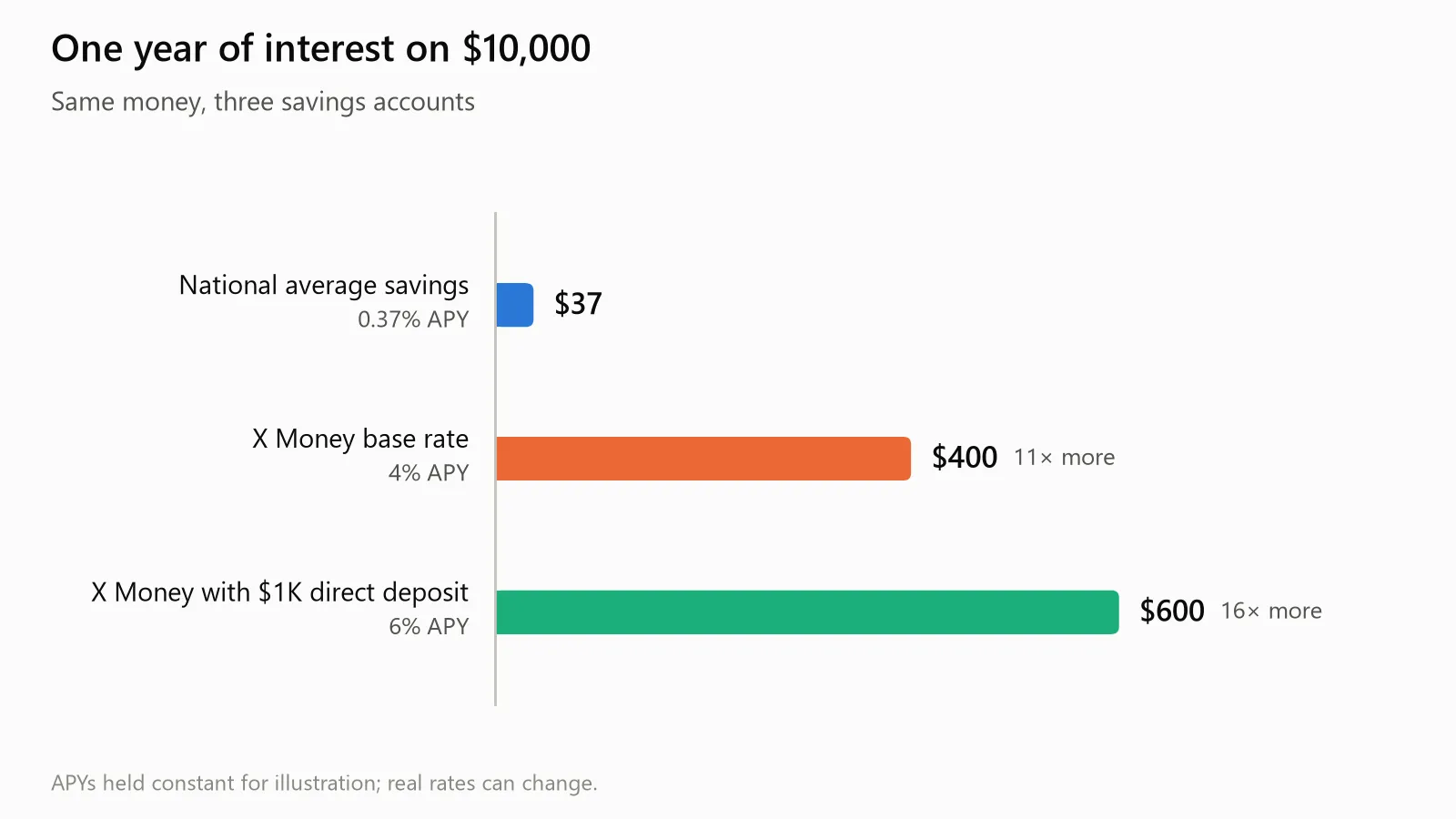
If you have $10,000 parked at 0.37% APY, that yields $37 over a year, or $3 a month.
$10,000 at 4% yields $400 a year/$33 a month. And at 6% $600 a year/$50 a month.
First and foremost, X Money is not a bank. It is a competitive fintech offering within the largest open forum of the internet.
What you actually get with X Money
The rate
- 6% APY with $1,000+ in payroll direct deposits (or X Creator payouts) within any rolling 34 days. No subscription needed.
- 4% APY without the deposit, which is still right in line with the best HYSAs out there.
- Interest accrues daily and pays out monthly.
Pay bills and mail checks (the part nobody’s talking about) Most high-yield savings accounts can’t pay a single bill. You have to move the money to checking first. X Money can:
- Pay bills right from the app.
- Mail a real paper check to a person or business for free, delivered in about 5–7 business days. Got an old-school landlord who only takes checks? You’re covered.
- Stop payment on a check if it hasn’t been cashed yet.
Moving money
- Direct deposit can hit up to 2 days early.
- Standard transfers in and out are free (1–3 business days). Instant transfers out cost 1.75%.
- Free, instant payments to other X Money users.
- Mobile check deposit and cash loads at participating stores.
The card
- Visa debit card with 1% cash back, or up to 3% when you hit the direct deposit requirement. Rent, utilities, Costco and a few others are excluded.
- Apple Pay and Google Pay, no foreign transaction fees, and ATM fee reimbursement (up to $4, twice a month on the free tier).
Fees No monthly fees and no inactivity fees. You basically only pay for speed (instant transfers), wires ($20 on the free tier), or a metal card ($25).
Safety X Money isn’t a bank. Your money is held at Cross River Bank (Member FDIC), and a sweep program spreads it across partner banks for up to $10M in coverage. Logins use a passkey (Face ID, fingerprint or device PIN).
Extras Up to 3 extra accounts (handy as separate savings buckets), joint accounts (beta), and beneficiaries.
Fine print New York residents don’t earn interest. You’ll get a 1099-INT if you earn $10+ in interest in a year. Full details are in the X Money FAQ.
How I use X Money
That 6% APY bonus I mentioned that requires you to direct deposit $1,000 a month?
You can transfer that money out the second it lands in X money and not void the 6% APY bonus.
My company uses Workday, and I went to my Pay and Benefits section, and set a new payroll election with X money’s info.
I get paid biweekly, so every two weeks my paycheck goes straight to X Money.
From there, I leave my monthly savings goal and use a free ACH transfer (takes 1-3 days) to route my spending and bills money into my bank (USAA).
Something to consider: you don’t have to commit every dollar of a paycheck.
You can set a payroll election for $500 going into X Money per paycheck and still meet the requirements for the 6% APY bonus without having to do the ACH money-shuffling.
(The $500 election only works if you are paid biweekly. Bimonthly earners will have to commit $1000 per paycheck)
What’s great about X money is the interest is accrued daily, and paid out monthly.
Seeing the interest hit your account like that is what keeps you saving consistently.
Bottom line
There are risks. Access to your money depends on your account staying active and the X platform staying up
If not enough people use the feature, X could realistically choose to discontinue the X Money offering.
Another consideration is that X Money itself isn’t a bank.
Your deposits are FDIC insured because they’re held at Cross River Bank, but that only protects you if the bank fails, not if X does.
When the fintech company Synapse went bankrupt in 2024, customers’ money sat frozen for months even though the banks holding it were fine.
Furthermore, APY/rates are variable. What’s 6% today could become 5% then 4% or lower.
Do I think X money is worth it?
Absolutely.
X Money is for anyone with a paycheck they can point at it. You’re building an emergency fund, saving for a move, or you’re just tired of earning $3 a month on $10,000.
It’s not for you if you want a branch you can walk into, you live in New York, or you can’t afford to have your money stuck for a few days if your account gets locked. Either way, keep a cushion at a regular bank.
If you’re already saving, you’ve done the hard part. Getting that money to earn 6% instead of 0.37% takes one direct deposit form.
Not financial advice. I am not sponsored by X. https://www.fdic.gov/national-rates-and-rate-caps https://money.x.com/en/i/faq